












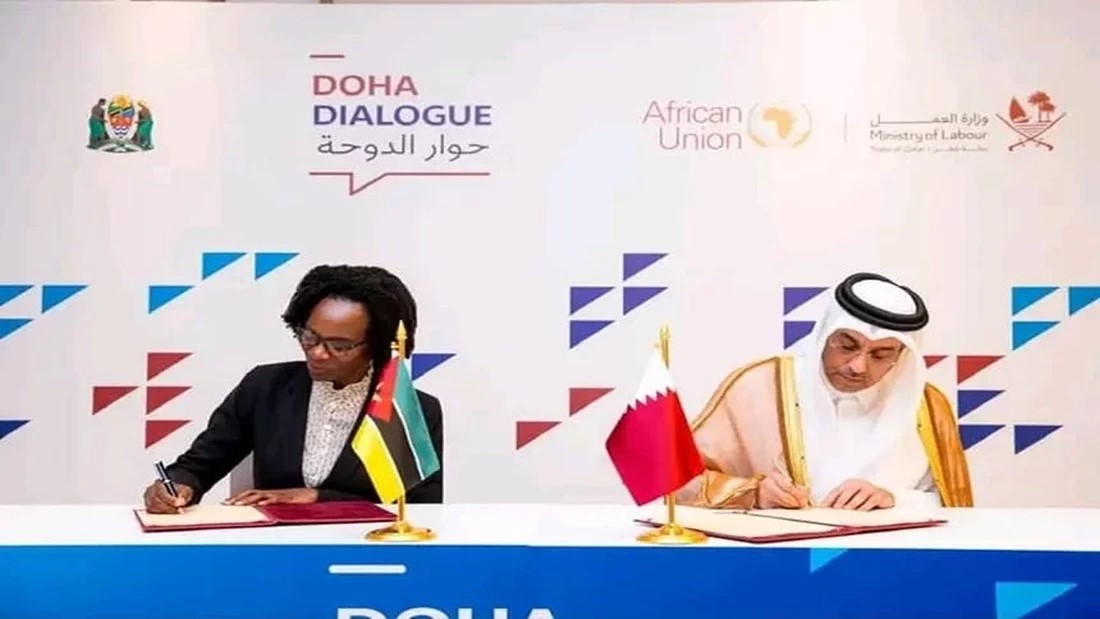
Authorities at the Ministry of Labor, Gender, and Social Action have strengthened the legal framework governing labour recruitment with Qatar through a memorandum of understanding.
The agreement is expected to facilitate the mobility of local workers to Qatar and to curb reliance on illegal channels has been under negotiations for two years.
“Therefore, we ensure that all matters guaranteeing that this mobility of Mozambican workers from Mozambique to Qatar occurs with complete safety, including social security and labor dignity, which is what matters most,” said the Minister of Labor, Gender, and Social Action, Ivete Alane told journalist.
The labor mobility agreement between Mozambique and Qatar was signed on the sidelines of the Doha Dialogue on Labor Migration, which concludes today in Dar es Salaam, Tanzania.
According to the executive branch, this agreement establishes a legal framework for the recruitment and employment of Mozambican workers in Qatar through safe, regular, and orderly channels, expanding foreign employment opportunities for Mozambicans while ensuring greater protection of their rights and improved oversight throughout the recruitment and employment process.
The Minister of Labor noted that the country has been monitoring situations involving Mozambicans who travel abroad for work without complying with legal mechanisms, stating that this agreement aims to halt illegal migration.
“This year we initiated the recruitment process for several Mozambican workers who are already in the United Arab Emirates and our expectation is that we can also establish similar frameworks with other nations, beyond our traditional agreement with South Africa for mine workers, which dates back to before national independence,” said the minister.
In July, Mozambique increased to 54 the number of citizens dispatched to the United Arab Emirates (UAE) under labor mobility initiatives, part of a recruitment drive targeting 300 professionals for the aluminum smelting sector.
In South Africa, the executive branch previously disclosed, over 9,000 Mozambicans have been placed since January across the mining and agricultural sectors, according to the National Director of Migrant Labor.
In Portugal, the Government has registered over 2,900 Mozambicans seeking employment under the bilateral labor mobility memorandum between the two countries, with contract formalization and placement processes currently underway. Opportunities primarily cover civil construction, domestic work, and transportation sectors.
The Government is likewise developing labor placement initiatives in Angola, Brazil, and East Timor as part of its strategy to establish formal migration channels.
The strategy to reinforce labor mobility comes after Mozambican President Daniel Chapo announced that the executive intended to redirect part of the Mozambicans affected by recent episodes of xenophobic violence in South Africa toward job opportunities in Portugal and the United Arab Emirates.
In July, Chapo told Lusa that more than 1,500 Mozambicans had been recruited in the first half of the year to work in Portugal, approximately 800 of whom were placed through the National Employment Institute under bilateral labor mobility agreements between the two nations.